Beginner guide
Build a patch
of sunshine
Your reptile has evolved over millions of years to harness the power of the sun. In our homes, that sun is gone, so we must do our best to replicate it.
Rebuilding sunlight
No single lamp is the sun
Every cell of a reptile’s body answers to sunlight. It drives their warmth, their digestion, their daily rhythms, and they manage it all by moving between sunshine and shade.
The goal of our lights is to create a patch of sunshine for our reptiles to bask in, and appropriate shade to escape it. Sunlight carries three types of light that a basking reptile uses: ultraviolet, visible light, and infrared. No single lamp can replicate sunlight, so our patch of sunshine requires at least three lights.
Switch each lamp on
That's the solar spectrum, and your reptile has evolved to use all of it.
How much
Sunlight changes by the hour. So does who basks
Morning sunlight starts gentle and grows more intense as the sun climbs toward midday. Different species bask at different points along that range, each seeking the intensity it is adapted to. The excellent “Reptile Lighting Guide” captures those differences in five basking levels, E to A, grouping species by the sunlight they seek.
Tap a level to see when it occurs and which reptiles use it
Level B Late morning
Strong sun of most open habitats.
Bearded dragons, sulcatas, ackies.
Reptile Lighting Guide, 2025. Roman Muryn, Dr. Frances Baines and Quentin Dishman.
Lamps vary in both intensity and spread, even within similar product families at identical wattages. This is why charting lamp intensity is so useful. One basking bulb might work great at the same distances as a particular UVB, while being inadequate for another. When we select lamps, we are fundamentally after a combination that produces proper intensity from the basking bulb and the UVB at the same distance.
Ultraviolet index (UVI) is used to describe the strength of the UVB. Power density, measured in watts per square metre (W/m²), describes the infrared energy emitted by the basking bulb. This is how we measure what you probably think of as heat. Surface temperature is a popular way to gauge basking intensity, but it is an unreliable proxy. Imagine you’re walking barefoot on a blazing hot day at noon. If you walk over grass, the ground might feel barely warm. However, step onto dark concrete and you could easily be burned. The solar energy shining on both surfaces was identical, yet the temperature of the surface was wildly different. Power density allows us to measure the intensity from above, rather than guessing based on how hot a rock gets.
To see how this works, we’ll walk through setting up the lights for a bearded dragon. Below, you’ll find simplified views of the reptile lighting tool to help you get used to everything. The tool keeps track of targets for you, but a bearded dragon is a late morning basker, so we’re aiming for a UVI of 4 to 5, a power density of 300 to 350 W/m² and around 30,000 lux.
Step 1 of 4 | UVB
Start with UVB
UVB reaching the skin starts a chain of reactions that produces vitamin D3. The body then converts that vitamin into active forms that regulate calcium absorption and metabolism. There are many more basking bulb options than UVBs, so it’s best to start with the UVB and find the basking bulbs to match it. The tool will let you quickly cycle through options to find a good fit. Keep in mind that there are many poor quality UVBs out there, ranging from useless to outright dangerous. When choosing a UVB, be sure it’s a good brand. This tool will never include a UVB that hasn’t been safety tested by experts in reptile lighting.
The UVB shown on the enclosure below is an Arcadia 24W 12%. As you can see by adjusting the platform, UVB intensity changes rapidly with distance. Raise the platform to achieve proper UVB exposure. The dragon will let you know when you’re there.
On target Vitamin D3 is in production! The platform locks in here.
Step 2 of 4 | Infrared
Basking bulbs
Basking bulbs emit infrared energy, the part of sunlight that warms a reptile’s body. The bulb shown on the enclosure below is an Exo Terra 150W Intense Basking Spot. Just like UVB, infrared intensity changes rapidly with distance. Raise the platform to achieve proper basking exposure. The dragon will let you know when you’re there.
On target Soaking up the warmth! The platform locks in here.
Multiple basking bulbs
A single basking bulb can work well, but adding a second bulb often improves spread and provides more even heating across a bearded dragon’s body. Where their beams overlap, the infrared energy adds together. The platform is fixed at the proper UVB distance, so adjust the bulbs instead. Move the bulbs closer together until the overlapping beams reach the target basking intensity. The dragon will let you know when you’re there.
On target Even warmth, nose to tail! The bulbs lock at 30 cm.
Step 3 of 4 | UVB and Infrared
Together
UVB and infrared should reach their target intensities in the same place, creating one complete basking area. The combined view below shows both at once, so we can find the distance where their target ranges overlap. Raise the platform until it reaches the overlapping UVB and infrared ranges. The dragon will let you know when you’re there.
On target Infrared and UVB together, just like the sun does it! The platform locks in here.
Step 4 of 4 | Visible Light
LED lighting
The final piece of our lighting setup is brilliant visible light. Bearded dragons come from incredibly bright environments, reaching upwards of 120,000 lux in full sun and close to 60,000 lux in the shade. With only a basking bulb and UVB, an enclosure will rarely reach 4,000 lux. Bright visible light supports circadian rhythm, hormone regulation, and visual perception, so we add an LED to bring the enclosure into the dragon’s target range. The LED shown on the enclosure below is a Sol Reptile VisionLED 54W mounted inside, allowing its light to reach the dragon without passing through the mesh. Just like UVB and infrared, visible light intensity changes rapidly with distance. Raise the platform to achieve proper visible light exposure. The dragon will let you know when you’re there.
On target Bright as a clear morning! The platform locks in here.
The finished setup
Patch of sunshine
Each type of light has a job, and the dragon uses all three together. The finished setup uses an Arcadia 24W 12% UVB, two Exo Terra 150W Intense Basking Spots spaced 30 cm apart above the mesh, and a Sol Reptile VisionLED 54W mounted inside the enclosure. With the dragon’s back 30 cm below the mesh, it receives about 4.6 UVI, a power density of 322 W/m², and 32,000 lux, all within its target range.
On target Ultraviolet, visible and infrared, all at once! The dragon basks in a finished patch of sunshine.
“A creature so deeply connected to the sun deserves nothing less than the full brilliance of Helios himself, because for dragons, light truly is life.” - Paul Symonds
In the enclosure
Placing the lights
In the wild, all three parts of sunlight arrive together, so all three lamps belong together, clustered at one end of the enclosure. UVB is most intense at the center of the tube, so the basking bulbs and LED should be centered on the UVB, lining up the strongest UVB with the most intense infrared and the most brilliant visible light. Nowhere in nature does strong UVB appear without infrared and bright light alongside it, and separating them in the enclosure can confuse the animal and interfere with its ability to regulate exposure.
The shaded end matters as much as the lit one. Moving between sunshine and shade, the animal takes in as much warmth and UV as it needs, exactly as it would in the wild.
The screen top
Mesh blockage
Every enclosure with a screen top blocks some amount of the light from passing through. UVB, infrared, and visible light are all reduced by the same percentage. A standard screen blocks about 35%. Ecoflex, Zoo Med, Exo Terra, newer Dubia, and Zen Habitats V3.0 enclosures all use mesh close to that figure, while Vivarium Electronics and Carolina Custom Cages block 45%.
Here is the finished setup with the platform already at its final height, but with the mesh ignored. Every reading except the LED comes in too strong. Raise the mesh blockage to 35% to match this enclosure and watch the intensities fall and the target distances shift as the screen takes its share. Only the VisionLED holds steady. It hangs below the mesh, so its light loses nothing.
Slide the blockage up to this enclosure's 35% mesh. On target The mesh is accounted for, and the distances are correct once again.
Lamp guards need accounting too. Guards are generally used on lamps mounted inside the enclosure, and their mesh takes a share of the light just like a screen top does. The Arcadia lamp guards block 35%. While guards are not ideal for bearded dragons, they are essential for many snakes. You can add a cage to each lamp in the app.
Not sure what your own screen blocks? The Reptile Lighting community can help you estimate your mesh.
The fixture
Dome offset
A basking bulb rarely ever sits directly on the screen. Its dome holds it somewhere above, and every dome is different. A shallow dome keeps the bulb within a centimeter or two of the mesh, while a deep one holds it much higher. The “Dome offset” setting in the app is simply how far the bulb’s face sits above the mesh.
Below, the two basking bulbs start far above the mesh, exaggerated so the effect is easy to see, and the basking spot reads weak. Lower the dome offset until the basking spot is back in range. The dragon will let you know when you’re there. With these bulbs, the power density is correct as long as they sit 0 to 3 cm above the mesh.
Slide the bulbs down until the basking spot warms back up. On target Anywhere from 0 to 3 cm above the mesh keeps this basking spot in range.
Trust, then verify
Verify with meters
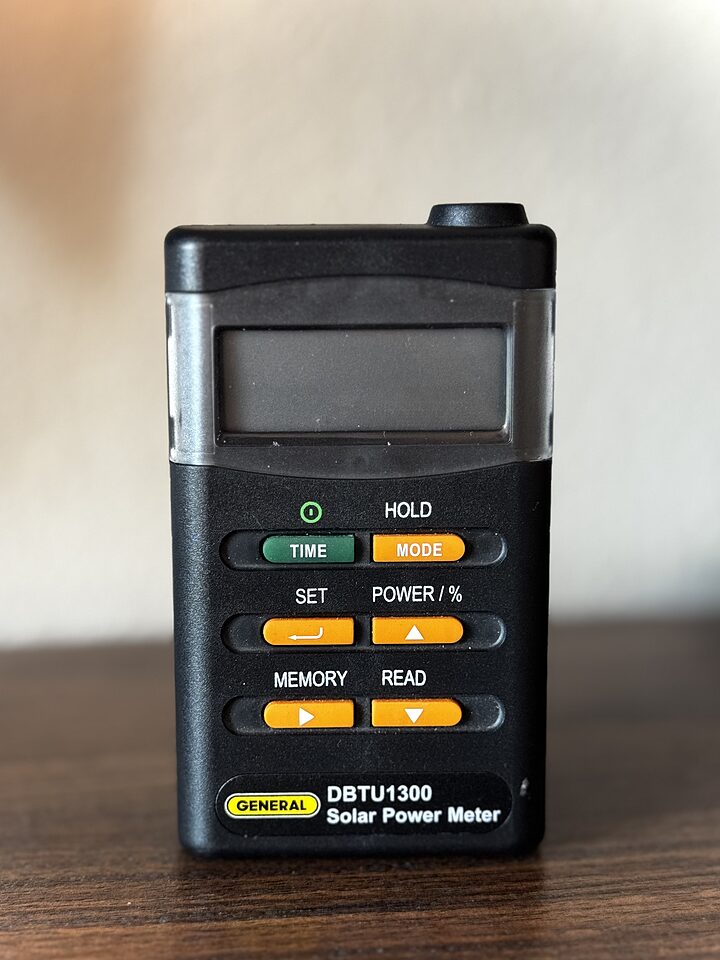
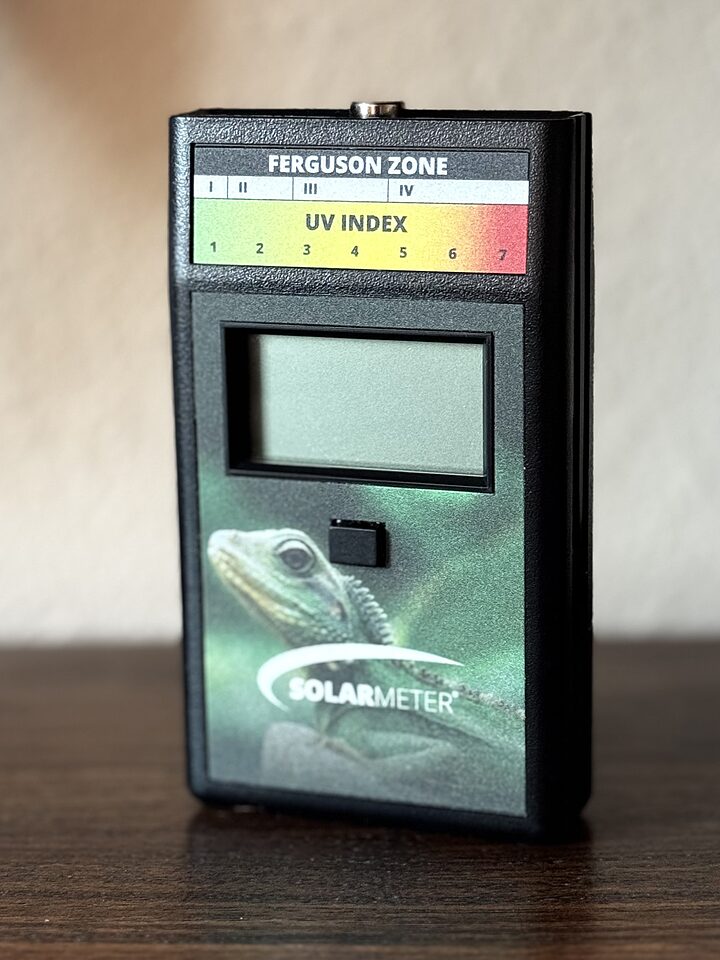
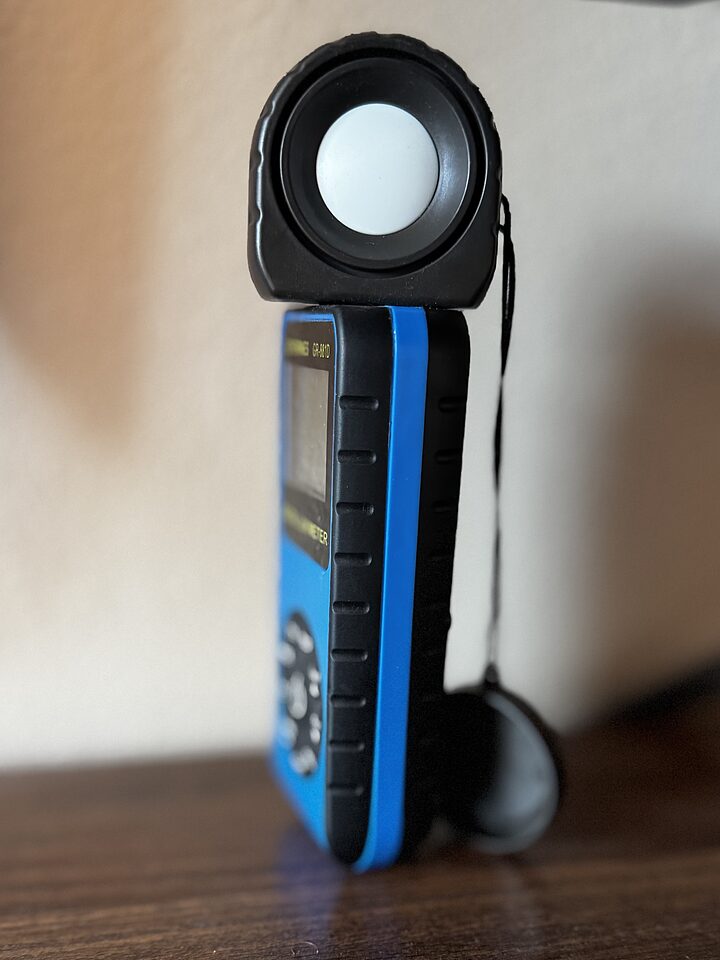
This tool estimates intensities with reasonable accuracy, but real-world lamps vary in their output, and measured readings are the most reliable path. Three meters cover the three parts of sunlight: the ISM400 power meter for power density, sold on Amazon as the General Tools DBTU1300, the Solarmeter 6.5 for UV index, and a lux meter for visible light.
For the power meter and the Solarmeter, the specific brand and model are very important. Knock-off meters will not provide comparable readings.
Take every reading at the height of the reptile’s back while basking, with the sensor pointed directly at the light source. Accurate readings with the power meter also require every light except the basking bulbs turned off, and the meter set to read in W/m² (it defaults to BTUs, which is not what we want).
Solar meters and power meters do not come cheap. Lux meters are far more affordable, so they can be a great starting point for those on a budget; there are several decent options, and the one attached below works well. A major goal of this tool is to help keepers who don’t have hundreds to spend on meters still get in the correct ranges for their pets.
These purchase links are Amazon affiliate links. Light My Reptile LLC may receive a small percentage of what you purchase after clicking them, at no additional cost to you. As an Amazon Associate, Light My Reptile LLC earns from qualifying purchases.
The final check
The hand test
The hand test is a final check that the basking spot is safe for your reptile. If your hand can rest on the platform under the running lamps for a full minute in comfort, the spot is almost certainly safe for a bearded dragon, whose scales are far tougher than your skin. For animals from the lower basking levels, expect a gentler feel. First light feels much different than late morning sun. Dr Frances Baines describes the method:
The "hand test" needs other lamps switched off. It works surprisingly well, because human skin is quite sensitive to short-wavelength infrared. You use your hand as a "reptile simulation". With any heat lamps placed over the basking surface to create a reasonably uniform oval (1 or 2 lamps) on the basking surface below, place your hand, palm down, on the basking surface and feel the rays from above on the back of your hand. The rays should feel like a very gentle, evenly spread, comfortable warmth, not hot, and perfectly fine for at least a full minute (time it) without feeling uncomfortably warm. The surface under your palm may not have been warmed up yet so ignore the temperature of that for now. If the lamp "passes this test" then it's very likely the irradiation is within the 250-350 W/m2 IR-A irradiance, because that's what full morning sunlight feels like on human skin.
Then to make sure the basking surface doesn't get too hot to sit on, follow up with a slow test - leave the lamp(s) on full for 3 hours then measure the surface temperature in the basking zone with a temperature gun. Is it a safe temperature? If so, you've got the lamp or lamp combination you want.
- Dr Frances Baines
You built your first setup!
You rebuilt the three parts of sunlight and blended them into one basking spot. You raised the platform until every reading sat in range, accounted for the mesh and the dome, and learned how to verify the results with meters and the back of your hand.
Many species have particular air temperature and humidity requirements that are beyond the scope of this article.
Open the full toolArticles and educational resources
- UVB Lighting for Reptiles by Dr. Frances Baines
- The New Age of Lighting and Heating by Roman Muryn
- Licht im Terrarium: Terrarium Lighting Science and Lamp Testing
- Tomaskas: Animal Lighting and Husbandry Resources