Why height matters for captive bearded dragons
As dusk settles over dusty outback roads, beardies work to capture the final rays of the setting sun. The evening heat gives way to night, and the beardies tuck themselves out of sight. Black-headed pythons begin their hunt, raiding the burrows of small, unsuspecting lizards and mammals. But our beardies survive the night, safely nestled away in the folds of an acacia tree. The first rays of dawn break over the horizon, and our beardies slowly emerge. Males climb high, soaking up the sun, scanning for predators, rivals, or mates. One particular male climbs higher, looking over his hard-fought territory. The higher he goes, the more visible his claim becomes. He perches there proudly, 3 m up a tree, pitch-black beard flared out against the brilliant morning sun. Nearby, a female gracefully navigates a low-lying bush, allowing her to bask while partially hidden. She peers carefully through the half-dead brush, ready to sprint up a tree at the first sign of danger. Both remain blissfully unaware of the Facebook comment sections insisting that their cousins overseas will die in taller enclosures; Wi-Fi can be quite spotty out there, after all.
Depending on your corner of the reptile internet, taller beardie enclosures can be a surprisingly controversial topic. Every few months, an unwitting poster will make the mistake of noticing that their semi-arboreal lizard does, in fact, enjoy climbing, and decide to ask about a 4x2x4 or similarly tall enclosure. On the internet, you might as well have asked about a basking platform for your fish. The comment section is swiftly inundated with every bit of alarmism you can imagine.
“Your dragon will fall and die!”
“Don't you know dragons are terrestrial? They need length, not height!”
“It's impossible to heat an enclosure that big!”
“Your dragon won't get enough UVB!”
“My 800 g German giant never climbs!”
Etc., etc., etc.
As you can probably tell, I've spent more of my life than I'd like to admit in those comment sections, arguing the other side. This paper isn't meant as a rebuttal to that silliness; many good-hearted keepers aren't opposed to vertical enrichment in principle, but they worry that taller enclosures are too difficult to light or create too much risk of injury. I want to make a broader case for going taller, and offer some practical tips for doing it well. I'm not arguing that every dragon needs a 4 ft tall enclosure, or that height should replace floor space. I'm arguing that height is a meaningful welfare variable for beardies, and that it's too often treated as an afterthought.
Foundation
Before making the case for taller enclosures, I think it's worth stepping back and asking what our enclosures are actually meant to do. I'd like to borrow some of Thomas Griffiths's framing here and think of the enclosure as a mini paradise: a place where our dragons can live well, feel secure, and express natural behaviors. Our captive dragons are not far removed from their wild cousins in Australia, and when in doubt, we should “refer to nature” (Griffiths, 2024). We have taken these animals out of the world that shaped them, and often ask them to live in conditions that would be entirely foreign to a wild dragon. That does not mean every part of nature is worth replicating. Captivity should spare animals from the obvious afflictions of the wild, but once those harms are set aside, the safest path is to stay true to the world they evolved to understand. When we design without natural history in mind, we risk building something that makes sense to us but offers little to the animal.
Wild
So, how do beardies use height in the wild? Dragons are adept climbers and will readily make use of vertical space when given the opportunity. Dr. Howard has described finding many dragons 2–3 m up trees. Males in particular seem to have “a need to survey and look over their territory and to be visible”. In the same interview, Dr. Howard explains that trees are also an escape route for both sexes, and recounts one beardie scaling a 30 m tall tree to evade his study team (Howard, 2023).
Season and air temperature also play a large role. Field observations from Alice Springs find that, “During hot weather, large males often slept on the rough barked trunk of a mulga Acacia aneura or Ironwood Acacia estrophiolata invariably at a height of around 2 meters” (McAlpin, 1995).
One study shows that the average perch height of beardies increases with air temperature, averaging 3–5 ft depending on time of day (Melville & Schulte, 2001; fig. 1):
“The semi-arboreal species P. vitticeps was recorded off the ground throughout the day. Only the three semi-arboreal species, L. gilberti, L. longirostris and P. vitticeps, showed a significant relationship between height off the ground and air temperature, where the lizards moved higher off the ground as air temperature increased.”
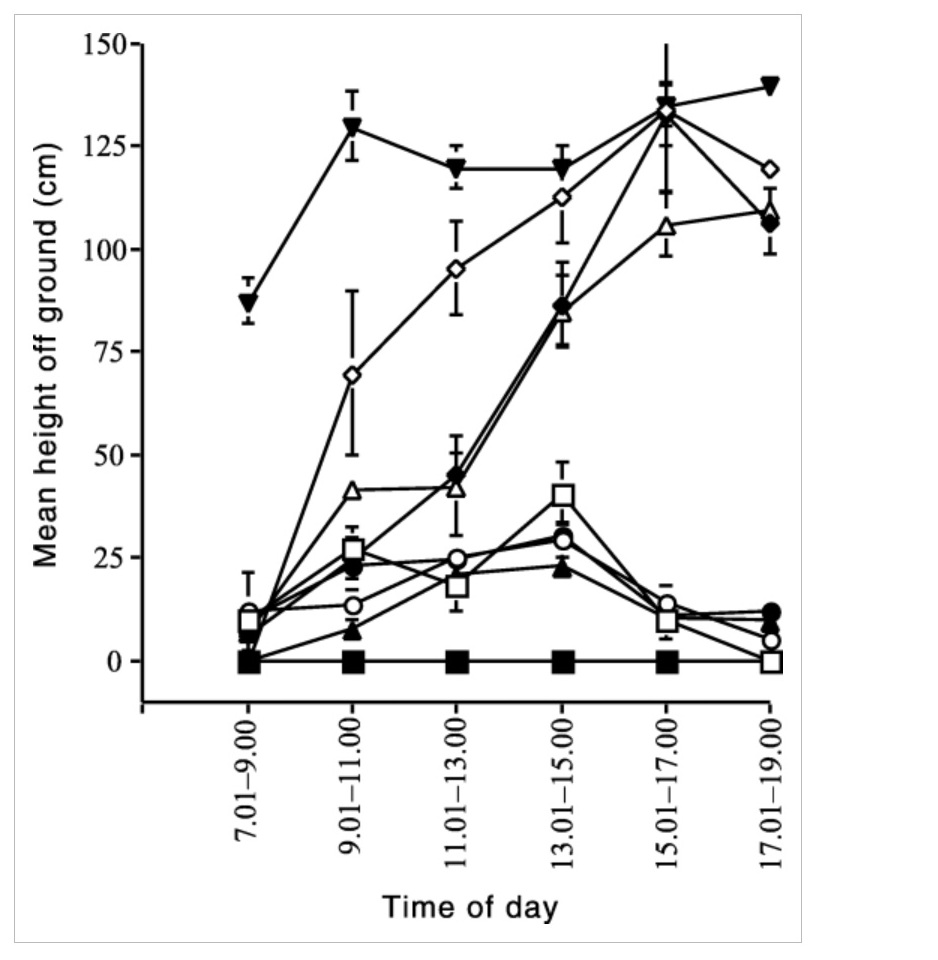
During periods of extreme heat, some males have been observed posting up in the same tree for weeks (Australian Museum, 2025; McAlpin, 1995).
Another ecological study found dragons regularly using perch sites between ground level and 7 ft off the ground. Frequency of elevated perch use varied quite a bit by season, with ∼80% of dragons found off the ground during summer months but only ∼20% found perching in the chillier winter period. The paper finds an all-season average perch height of ∼2.2 ft off the ground (MacMillen et al., 1989).
I could go on, but I think it's clear that vertical space is fairly important to a dragon's daily life. At the same time, we shouldn't lose sight of the fact that dragons are frequently found at ground level across all seasons, particularly during cooler months, so terrestrial space is just as important to provide. Our beardies are more arboreal than many give them credit for, but they are not primarily tree dwellers. So what does height mean to a dragon? It means safety from ground-based predators, an observation post to survey territory, a comfortable sleeping spot, and shelter from hot days.
Captivity
Now that we have a sense of wild height usage, we can turn to the practicalities of providing this in captivity. A captive environment will always come with some compromises. Many dragons will roam over distances of 1 km or more in the wild, something we cannot hope to provide in our homes. Similarly, it would be quite difficult to set up an enclosure with access to a 3 m tall tree. While that represents an extreme, most captive dragons don't even have access to their average observed perch height of ∼2–5 ft off the ground. However, unlike 1 km of territory or a 3 m tree, we can actually reasonably provide climbing opportunities that match the low end of wild dragon preferences.
The trouble with 2 ft
4x2x2 is now the commonly accepted minimum enclosure size for a bearded dragon. While this is a significant improvement on the 40-gallon tanks of the past, it's still limited in many ways. When designing an enclosure, climbing enrichment is fundamentally in tension with both substrate depth and lighting. Both can take up an enormous amount of enrichment space when not being utilized, which is most of the day, as dragons don't bask or dig for the majority of the day. Figure 2 illustrates this point well.
4x2x4
4x2x2
6 inches of substrate is a decent low end for burrowing utility. It's not deep enough for a full burrow, but it allows for some light digging without immediately hitting the floor. If we assume 6 inches of substrate in a 4x2x2, with internally mounted lights, we only have 16 inches between the UVB and the floor. That makes the Arcadia 24 W 12/14% unusable unless the basking spot is literally at floor level, and even lower-powered UVBs allow for little in the way of an elevated basking spot (Reptile Lighting, n.d.). This is why external lights often work better for shorter enclosures. Even with external lighting, the best we could do in terms of climbing opportunities is only 18 inches off the ground.
Now, consider the 4x2x4 (fig. 2). Much deeper substrate is now possible and recommended to cushion falls and develop burrows. I budgeted 10 inches here, but you could easily offer more. An Arcadia 24 W 12/14% could comfortably be used at these distances, or even parallel T5s for a wider spread. The dragon now has a reasonably elevated basking platform, around 18 inches off the ground, and plenty of space on the cool side for some meaningful climbing opportunities. The elevated basking platform can also be designed such that it doesn't inhibit terrestrial space below, something I would definitely recommend in a 4x2x4, since space is limited.
I am not necessarily espousing the wonders of the 4x2x4. I'd actually much rather see something like a 6x2x4, 8x2x4, or even an 8x4x4 (I'll get there someday). But in my mind, a 4x2x4 is significantly better than a 4x2x2, 5x2x2, and maybe even a 6x2x2, depending on the dragon. I can say that it's probably worse than an 8x2x2 or a 6x3x3, though. These aren't objective judgments, just my feelings based on how I've seen dragons use space.
My beardie enclosures are 8x2x4, so I've had some practice designing taller enclosures and obsessively watching how my dragons react to changes. We'll get to lighting in a minute, but here are some general pointers for setting up a taller enclosure:
Try to make the walls climbable. This can be done with cork bark panels, a spray foam background, or cleverly attached branches and shelves. Make sure to allow for open terrestrial space below. Many beardies love to run, and they should be able to do so without too much difficulty. Complexity for beardies is a bit different than it is for many snakes. Many beardies like to look out over open space, which is difficult to accommodate in an enclosure that must be many times more dense than their wild habitat. I often place the thinner ends of branches and cork rounds on the ground so as not to take up too much floor space.
The goal is to create layers and multiple meaningful places to be, not simply stack floors on top of each other. While layering is important, I would caution against the multi-floor, condo-style beardie enclosures you sometimes see. Those often lose much of what makes a tall enclosure special: meaningful vertical space.
Light
Lighting a taller enclosure is actually fairly similar to lighting a shorter enclosure. In fact, it can be identical, just higher up. Height does offer more freedom with lighting, but it doesn't compel any special creativity. The simplest form involves creating an elevated spot, using a shelf, sturdy stool, or long branch, and then building easy ways to access that basking spot. There are many ways to go about this, and a spray foam background is definitely not required, though they look nice and provide additional enrichment. At the end of the day, we still want to create a patch of sunshine with ∼UVI 4–5, 300–350 W/m2, and ∼30,000 lux, evenly covering the dragon's body (Baines, 2024; Muryn, 2024; Reptile Lighting, n.d.).
Some things do change when moving to a taller enclosure. The basking spot and LED positioning need to be spot on. In shorter enclosures, the dragon basically only needs to move side to side when thermoregulating, and there's more margin for error with LED positioning. In taller enclosures, we need to communicate not only to move left or right, but to move upward for full basking. Some of this is intuitive, as dragons often ascend to bask, but a complication of artificial lighting is that it's significantly shallower than sunlight. In natural sunlight, you might take a reading with your Solarmeter at ground level and get ∼UVI 4. If you were to then climb to the roof of your house and measure the UVI again, it could easily still be ∼UVI 4. In other words, there's no reason in a dragon's mind that bright patches spilling down to the lower levels shouldn't work just as well as the basking spot. This is quite annoying for growing plants, but the dragon is the priority.
When I first built Nini's enclosure (fig. 3), I had issues with this because the right basking spot was very high up, somewhat narrow, and near the wall, so it was difficult to effectively position the LEDs over it without too much spillover. I would sometimes observe Nini come out from her cork log in the morning, slink toward an exposed area, perhaps climb to the middle shelf, and then sort of just wait to warm up, which obviously wasn't working. I corrected this by bringing the basking spot lower and away from the wall so I could create a larger “patch of sunshine.” (fig. 4)
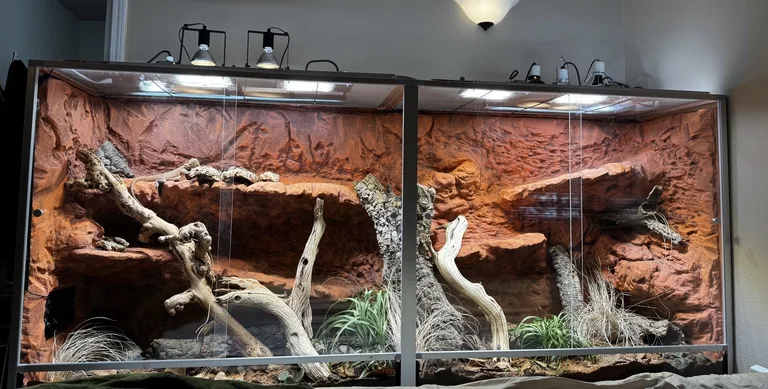
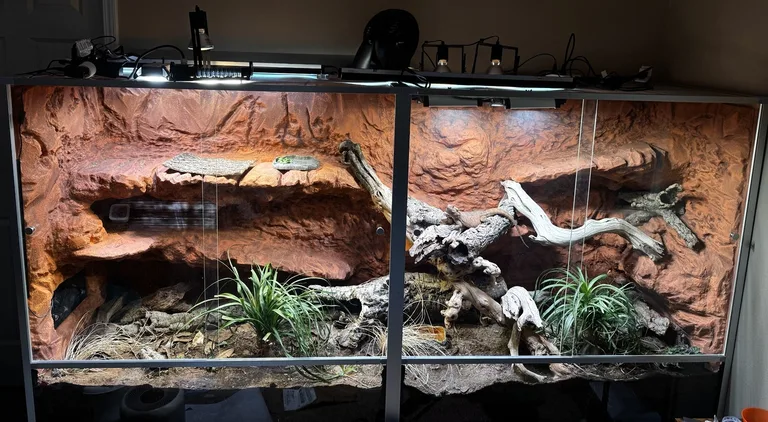
As I hinted earlier, taller enclosures allow much more freedom with lighting. A big advantage of 4 ft in height is that you can create more and larger basking spots. You'll notice that my 8x2x4 enclosure uses three T5s, two of which are 36 inches. This would seem to violate the common recommendation of UVB covering “no more than 50% of the enclosure,” but that rule is really meant for short enclosures. Light intensity falls off rapidly with distance, and even though I'm using three fairly powerful UVBs, most of the enclosure volume has a UVI of 0. Since there's ample space to escape the basking radiation, the longer UVBs are a positive, as they provide a larger and more even spread during basking. Shorter T5s are often limited, as the dragon need only move a few inches in any direction before much of their body is out of their ideal basking UVI. Nini can be sitting in many different places on the basking spot while still receiving optimal levels of basking radiation. It's important to match this wider spread with proportional NIR and visible light, which I do with two 100 W Eco Halogens and two Sol Reptile VisionLEDs.
Finally, 2 ft tall enclosures only really have one air temperature. Many dragon keepers will find this surprising, given the peculiar industry focus on “warm side air temperatures.” The reality is that, in the vast majority of enclosures, the only meaningful gradient is one of light and shade. Hot air rises due to differences in density, entrains surrounding air, and mixes quickly; what it does not do is sit in stable, adjacent columns of significantly different temperature within a 4 ft box. That idea is an unfortunate misunderstanding that has worked its way into many modern care guides. Those “warm side temperatures” are mostly measurement error, caused by exposing the thermometer to basking radiation. Thermometers were designed to work within a Stevenson box, not to bake under a basking light.
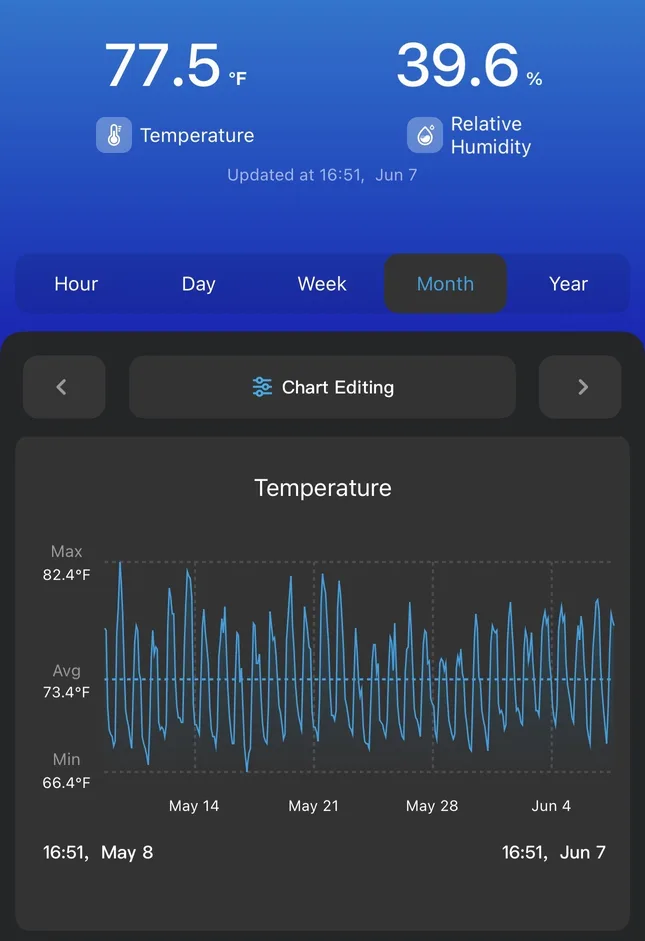
A 4 ft tall enclosure is different. Heat naturally rises, and that extra height is often enough for a vertical air-temperature gradient to emerge, particularly in solid-top enclosures. Nini frequently chooses to sleep on the top shelf of her enclosure, high up in the warm air (fig. 5). Given how often I was warned about the difficulty of heating an enclosure of this size, it's a bit ironic that my bigger problem is usually the opposite. On many days, I have to run the fans at full tilt to prevent the enclosure from overheating. (fig. 6).
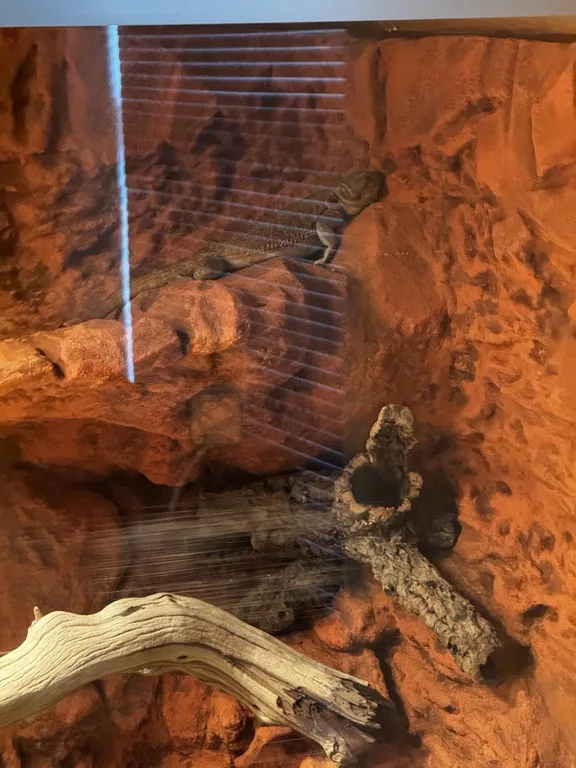
This paper is not meant to serve as a full lighting guide, so I highly recommend starting with the beginner guide to reptile lighting and then reviewing the resources in the reference list for a much more complete treatment.
Exceptions
While I strongly believe that height should be increasingly prioritized for dragons, it's not right for every situation. There are the obvious cases of quarantine, illness, or injury. A dragon with MBD or MD obviously doesn't need 4 ft of height, but there are some less straightforward cases I should also touch on.
Many captive dragons are overweight. While a slightly overweight dragon will do just fine in a tall enclosure, cases of extreme obesity could present serious fall risks or mobility issues. Your 800 g “German giant” might need a diet before he gets his tall enclosure. In a similar vein, I would not recommend using taller enclosures without substrate. In a properly designed 4 ft enclosure, a dragon will only really be able to fall 2–3 ft. Nini has jumped from the higher areas of her enclosure down to the substrate many times. For a healthy dragon landing on soft dirt, that isn't especially concerning. But the same fall onto solid rock would be an entirely different risk profile.
Finally, not all dragons care equally about climbing. Some female dragons will climb occasionally but are much more concerned with other activities. In those cases, a strong argument could be made for prioritizing other aspects of the enclosure. Nini certainly isn't like that. She still tries to climb higher than the 4 ft of the enclosure allows, but every dragon is different, so tailor these suggestions to your specific situation.
Final thoughts
This article is by no means exhaustive, but I hope it provides some useful insight into what height means to beardies and how we as keepers can work toward cultivating their mini paradise. When it comes to advancing reptile husbandry, none of this advice is all-or-nothing. I personally believe 4 ft of height best balances complexity and enrichment, but 3 ft is certainly much better than 2 ft. Even 2.5 ft would be an improvement. My dragons currently live in 8x2x4 enclosures, and I like to think they live pretty good lives. Would they be better off in 8x4x4s? Of course! And I'd love to be able to provide that for them someday. So I hope what readers will take from this is not that “4 ft is the new minimum!” or other such dogma, but that taller enclosures are a welfare improvement and should be a serious consideration when designing our beardie habitats. When you plan your next build or upgrade, I hope you'll give height an extra thought.
References
- Melville, J., & Schulte, J. A., II. (2001). Correlates of active body temperatures and microhabitat occupation in nine species of central Australian agamid lizards. Austral Ecology, 26(6), 660–669.
- MacMillen, R. E., Augee, M. L., & Ellis, B. A. (1989). Thermal ecology and diet of some xerophilous lizards from western New South Wales. Journal of Arid Environments, 16(2), 193–201.
- McAlpin, S. (1995). Notes on the central bearded dragon Pogona vitticeps in Central Australia. Monitor: Journal of the Victorian Herpetological Society Inc., 6(3), 111–115.
- Australian Museum. (2025). Central Bearded Dragon.
- Baines, F. M. (2024, August 20). UVB lighting for reptiles. LafeberVet.
- Howard, J. (Interviewee). (2023). The complete guide to bearded dragons (with BeardieVet). Reptiles and Research. YouTube.
- Muryn, R. (2024, November). The new age of lighting and heating. Exotic Keeper Magazine.
- Griffiths, T. (2024). Why 4x2x2 (120g) is the minimum. Facebook.
- Reptile Lighting. (n.d.). Reptile Lighting [Facebook group]. Facebook.